DrugDoseUnit conversionRoute
Verify
Every verbal order gets ten seconds to be read back. Drug, dose, unit and route are compared, so 0.1 mg and 100 mcg agree while rocuronium and succinylcholine do not.

Surgr listens to the operating room, checks each drug order against its read-back in real time, tracks the WHO Surgical Safety Checklist as the team speaks it, and speaks up the moment a loop does not close.
Every verbal order gets ten seconds to be read back. Drug, dose, unit and route are compared, so 0.1 mg and 100 mcg agree while rocuronium and succinylcholine do not.
The WHO Surgical Safety Checklist ticks itself as the team speaks. A phase that ends with gaps, or an incision called without a Time Out, raises an alert.
Alerts are spoken into the room word for word through AssemblyAI's Voice Agent, and every order, item and event lands in an audit-ready record linked to the audio.
Closed-loop communication is the standard: an order is spoken, repeated back, and confirmed. In a busy room the repeat is skipped, a dose is misheard, a checklist item is assumed. Nothing beeps. Surgr is the thing that notices.
perioperative medication administrations involve an error or adverse drug event
major complications after adopting the WHO Surgical Safety Checklist; deaths fell from 1.5% to 0.8%
sentinel events involve a breakdown in team communication
major operations are performed worldwide every year
Room audio streams to AssemblyAI at 16 kHz. Medical mode gets drug names and doses right; speaker labels tell surgeon, anesthesiologist and nurse apart on one microphone.
A deterministic classifier parses orders, read-backs and checklist statements in under a millisecond. Utterances it cannot settle go to the LLM Gateway under a strict JSON schema.
Every order gets ten seconds to be read back. Wrong dose, wrong drug, wrong route or silence, and Surgr speaks the alert into the room through the Voice Agent API.
An operative communication record where every medication, checklist item and safety event links to the exact second in the audio, with JSON export and a print view.
The display exists for the circulating nurse, the debrief and the audit. The alerts are spoken. The record writes itself.
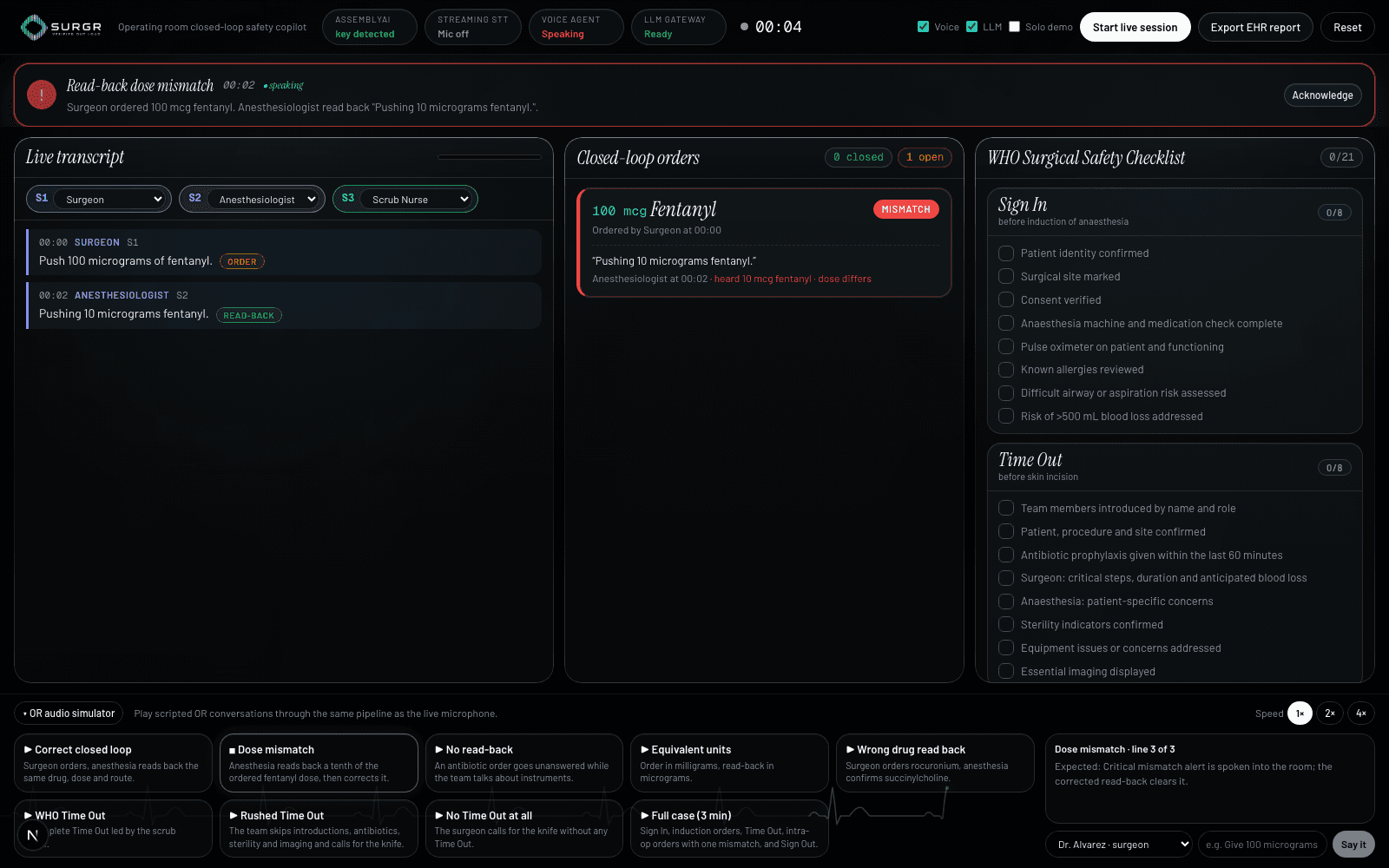
Surgeon, anesthesiologist and nurse in their own colours, every order and read-back tagged as it lands.
A ten-second countdown per order. A mismatch goes red and stays red until a correct read-back arrives.
Sign In, Time Out and Sign Out complete from speech; a phase that ends with gaps raises a spoken alert.
Every integration was verified against the live services: a streaming session with medical mode and speaker labels, a Voice Agent reply spoken verbatim, and JSON-schema outputs from the LLM Gateway.
Sub-second transcripts from the room microphone. Medical mode formats drug names and doses; keyterms boost 47 operating-room drugs and checklist phrases.
One microphone, three roles. Speaker embeddings separate the team in real time, so a read-back from the wrong person is caught.
Structured classification for the utterances rules cannot settle, and the narrative sections of the operative record. Rate budget tracked from the gateway's headers.
Surgr's voice in the room. Alerts are spoken verbatim through a persistent agent session, with browser speech as a fallback.
The simulator plays scripted operating-room conversations through the same pipeline as the live microphone, so you can trigger a wrong dose without an operating room. Turn your sound on.
Surgeon orders, anesthesia reads back the same drug, dose and route.
Anesthesia reads back a tenth of the ordered fentanyl dose, then corrects it.
An antibiotic order goes unanswered while the team talks about instruments.
Order in milligrams, read-back in micrograms.
Surgeon orders rocuronium, anesthesia confirms succinylcholine.
A complete Time Out led by the scrub nurse.
The team skips introductions, antibiotics, sterility and imaging and calls for the knife.
The surgeon calls for the knife without any Time Out.
Sign In, induction orders, Time Out, intra-op orders with one mismatch, and Sign Out.
No. It is a hackathon prototype built to show what real-time closed-loop verification can look like. It is not cleared for clinical use and does not replace clinical judgement or institutional protocols.
Every AssemblyAI integration is live: streaming transcription with medical mode and speaker labels, the LLM Gateway, and the Voice Agent that speaks the alerts. The simulator injects scripted text into the same pipeline so a wrong dose can be triggered without an operating room, and the demo above runs the real engine in your browser.
The simulator, the rule-based read-back engine, the checklist and the local report all run without any cloud call, and the voice falls back to the browser's speech synthesis. The live microphone, spoken alerts through the Voice Agent and the LLM narrative need a key, which stays on the server.
The rule classifier decides in under a millisecond. A mismatched read-back is spoken within about a second; an unanswered order is called out after the ten-second read-back window.
The browser streams directly to AssemblyAI using a short-lived token minted by the server; the API key never reaches the page. Streaming PII redaction can be enabled for the exported record.
Hackathon accounts get two gateway requests per minute. The deterministic classifier does the real-time work, and the LLM is reserved for drug-related utterances the rules cannot resolve and for the end-of-case narrative. Rate limits are read from the gateway's headers and honoured automatically.